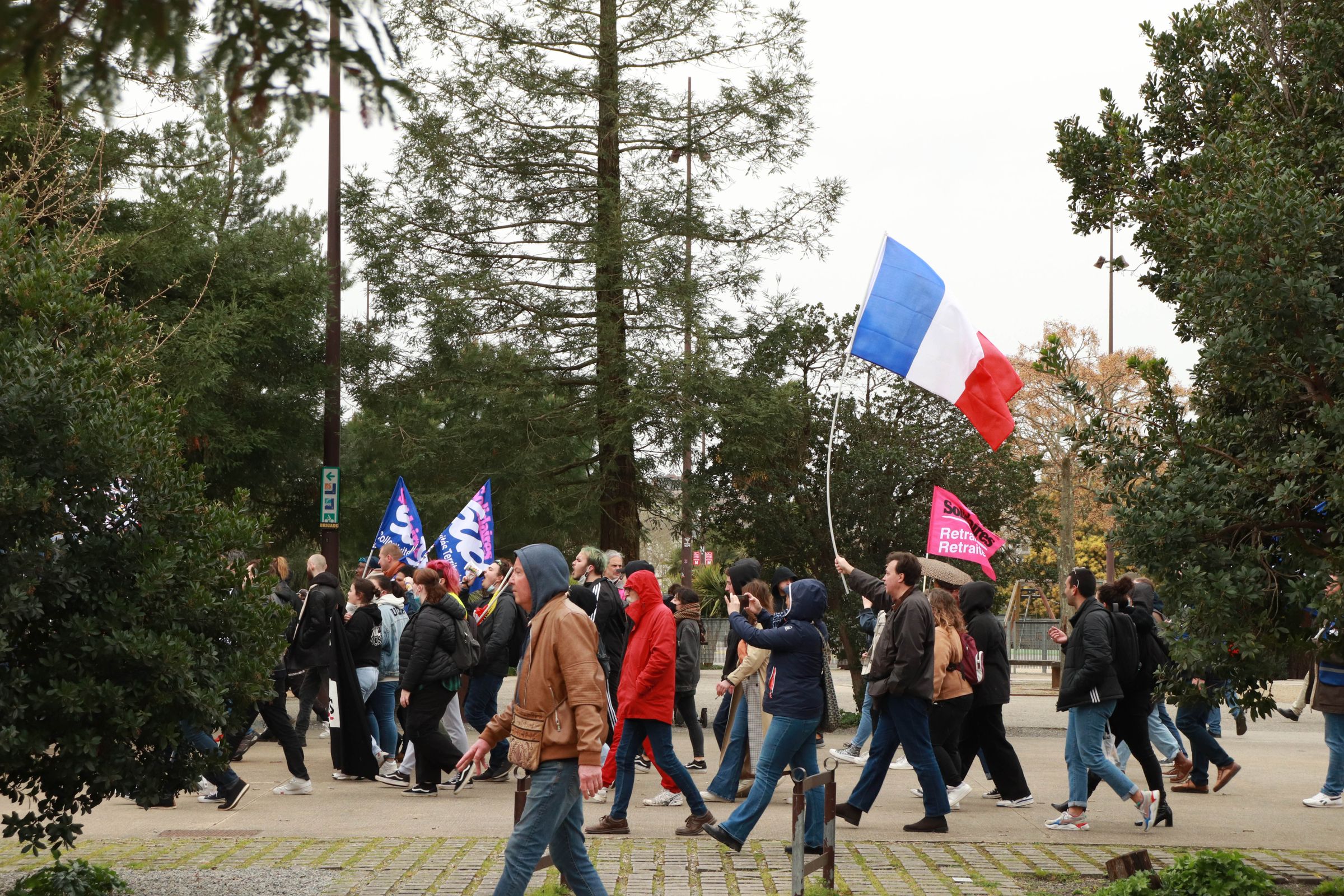
When French teenagers set out for school in recent weeks, some of them ended up in hospital instead of in class. Lawyers and rights groups say several minors have suffered injuries they compare to wounds from war, sustained at the hands of police weapons during the country’s biggest youth protest movement in decades. For families, teachers and the wider public, the question now pressing on France is whether the state’s response to school blockades has crossed a line that a democratic society should not cross.
The movement is now in its fourth week. Hundreds of high schools across the country have been blockaded by students demanding the replacement of absent teachers and repairs to decrepit buildings. What began as a protest over the everyday conditions of public education has become a national reckoning over how children are policed, arrested and held.
The most serious allegations concern the weapons used. Evan, a 15-year-old carpentry student at a vocational high school, lost his left hand when a police stun grenade exploded outside a school protest in Lens, northern France, on 5 October. He also lost several fingers from his right hand and was injured elsewhere on his body. His lawyer, Bertrand Wattez, said his injuries resemble war injuries. According to Wattez, Evan had gone to school to attend class and found a protest under way, had taken no part in violence, and had not picked up the grenade from the ground, contrary to the account given by the Béthune state prosecutor. Evan remains in hospital in a very difficult condition, and his family has filed a criminal complaint.
In Saint-Ouen-l’Aumône, north-west of Paris, Eden, 14, suffered extensive facial injuries after allegedly being hit by a shot from a grenade launcher: two fractures to his jaw, the loss of his bottom teeth and all his top teeth broken. His lawyer, Elsa Marcel, said the shot was fired at close range, from a distance of 1.5 metres, and called it the equivalent of war weaponry. The family has filed a legal complaint for attempted murder. Video footage appeared to show Eden, who had found his school blockaded and wanted to go home, facing three riot police officers; one struck out in his direction with a truncheon before the grenade shot was fired. An officer has been suspended and placed under official investigation.
Meanwhile, in Tours, a police officer was charged this week with aggravated battery after Maël, a 16-year-old vocational student, lost the use of his eye, allegedly after a shot from a form of rubber-bullet launcher. The officer denies the charges. The family’s lawyer said Maël had simply been present at a school protest, not involved in any violent confrontation, and that the family felt a sense of injustice.
The interior minister, Laurent Nuñez, told the senate that police have opened internal investigations into 36 allegations of officer violence against demonstrators, including four children allegedly mutilated by explosive weapons and six sustaining significant injuries, alongside complaints over blows, insults and alleged sexual assault. He denied any form of excessive policing or police repression, and has suspended the use of stun grenades at school demonstrations.
Beyond the injuries, lawyers are raising alarm about an unprecedented number of children taken into police custody. Since the protests began in mid-September, 6,773 under-18s have been held, the justice ministry said. More than 1,000 faced no charges; 2,190 are facing legal action; almost 2,000 were given an alternative to prosecution, such as a citizenship course, without trial or conviction. Accusations included gathering with violent intent, violence against police and damage to property.
Nathalie Tehio, a lawyer and president of the French Human Rights League, said the fact that only a minority of cases reach a judge raises concerns that arrests may be unfounded. “There are a record number of arrests … Often, the legal dossiers are empty. In reality, this is more about stopping people from demonstrating. I think there is a sense of hitting hard to try to dissuade people and scare them,” she said. Lawyers including Romain Boulet, co-president of the Association of Criminal Lawyers, and Mohamed Jaite of the Syndicat des Avocats a France reported accounts of teenagers being hit, humiliated, or subjected to racist, sexist and homophobic insults during arrests. Prisca Ancion and Romane Bartoli of the Collectif d’Action Judiciaire, which demonstrated outside a high school in Saint-Denis this week, encouraged families to file complaints.
One 16-year-old, arrested 100 metres from his school during a late-September blockade and held for more than 12 hours, said he was hit with a truncheon and punched, and heard an officer tell him “It’s always you lot,” which he understood as a racist insult. He was released on condition of a citizenship course. The justice and interior ministries did not comment on the allegations. Audrey Bailleul, a magistrate with the Union Syndicale des Magistrats, said it was too early for a clear view: “There is nothing to show that there has voluntarily been a massive intention to not respect [legal] procedure.”
France has faced scrutiny over explosive police weapons since the 2018-2019 gilets jaunes demonstrations, when people were reported to have lost eyes and suffered mutilated hands and feet. What is different now, lawyers say, is that the people bearing these wounds are children, and the issue at stake is the public’s right to protest safely. Whether the internal investigations and the suspension of stun grenades at school protests will be enough to restore that right remains the open question hanging over the movement’s fifth week.